For god's sakes, just let property owners do what they want with their property (within limits of safety). If they want to keep it empty or a small 1 family house, let them, and don't let their neighbors or city government bully them into building larger. If they want to build (or sell to someone who will build) a large apartment building, let them do that too.
You'll gradually get more density and less traffic this way over time, assuming that's what people want (and if it's not, they'll get what they want instead)
The root of the problem is the impulse to be disgusted by your neighbor's choices, and wishing to harness violent force (government rules) to force your neighbor to conform to your wishes. Enough already.
Well obviously they're still "allowed" to do whatever they want - (usually) no one's forcing you to sell the quaint victorian and move into the new Gulag of an Apartment complex.
Everyone essentially agrees with you. The problem is that when ONE of these people wants to build the next Trump Tower on top of grandma's old cottage, the "live and let live" ethos goes out the window - everyone's at city council decrying mixed zoning or whatever else they think is "ruining" their neighborhood! There's a reason the term NIMBY exists, there's a reason we don't like living next to Sriracha factories or concert venues and don't just let people turn their houses into one of them at will.
  We live in a society and the law is a reflection of it,
  especially in cities where a lot of   people with different
  needs and desires have to get along. If you want to literally
  do whatever you want on your property, there's lots of places
  (in Alaska) that you can do that.
Hell, I actually agree with you, and that's why I'm eventually going to move somewhere where I don't get woke up by traffic every morning, where I don't get stuck in traffic, where I can play music as loud as I want, and celebrate Pagan holidays with massive bonfires until 7am. But until then, I won't live under any illusion of living in a libertarian paradise, because it's just not a viable outcome for city dwellers.
Assuming the noise or smell was somehow contained, what's wrong with living next to a concert venue or sriracha factory? I should merely have a right to my property being as smell, noise, and shadow free as it was when I bought it. I should /not/ have a right to anything more than that.
Enshrining a right to only live next to other residences is how we end up in this problem of boring neighborhoods that require lots of travel just to get to where you want to go.
In old large eastern US cities and in towns of any size in other countries I've been in (Mexico, Japan) there is MUCH more mixed use. You might see a motorcycle repair shop in between a couple of regular single family homes. Nobody seems to mind. I don't get why we're special and weird like this.
Most of lower Manhattan, which is so valued now, could not be built legally today. It was built before zoning codes.
I'm not against mild zoning codes that merely slow down rather than block change. For example, rather than a named maximum height, say that no building can be built more than twice the average building height in the area within a certain radius. Or, the percentage of nonresidential uses within an area cannot increase by more than 2% per year, or something.
This way in the short term, a neighborhood cannot be transformed overnight. But, it can be transformed slowly over decades towards what the market will bear, ie what people actually want and are willing to pay for.
This isn't a libertarian fantasy, it's just how towns used to work in the US before zoning and how they work in many other less backwards parts of the world...
Personal anecdota: My parents' house shared the block with a carpentry shop (now bankrupt) and a Christian church (which later moved to another site). The sound of the carpentry shop was a thousand times more tolerable (although it was daily) than the sporadic religious celebrations with its drums and electric guitars.
> I should merely have a right to my property being as smell, noise, and shadow free as it was when I bought it. I should /not/ have a right to anything more than that.
I feel like the other commenters are missing that this is the debate. If you choose to move in next to a concert venue, that's your prerogative. If one opens next door, this is when NIMBYism kicks in. Cities need to evolve, and existing owners speaking out against loud businesses or view-blocking skyscrapers or whatever it may be prevent this from happening. Whether this is virtuous or not is up for debate, but it's certainly a limiting factor.
> Assuming the noise or smell was somehow contained, what's wrong with living next to a concert venue
The massive amounts of traffic (foot\car) these things can generate, depending on the city and size of the venue. The noise from that many people on the street is not containable.
The same with a new 1000 unit apartment complex going up next to you - it's going to have a massive impact on local services around you, depending on what was there already. Your idea about disallowing large changes isn't horrible.
This especially important because you can't expect the city to have to suddenly significantly enlarge the roads or improve the traffic control measures (lights, signs, etc.) overnight. If it grows up slowly, organically, then the regular rebuilding of infrastructure will naturally accommodate the building up of the area.
> Assuming the noise or smell was somehow contained, what's wrong with living next to a concert venue or Sriracha factory
Pretty big assumption, my friend. Generally they're not, or they're not contained well enough, or people are just old and grouchy so they go form homeowners associations and ban Sriracha factories. That said, I do agree with your overall outlook here, I'm just afraid that a lot of (particularly older, more traditional people) don't, so it's unrealistic to expect change. People don't like change, and they sure as hell don't like changing the way things change.
> I'm not against mild zoning codes that merely slow down rather than block change.
I was thinking along similar lines, yet I suspect that this won't happen for various reasons even if NIMBYism is discounted. The layout of many suburban communities is less than ideal for commercial development, even something as innocent as a convenience store, since they are low density and unwalkable for community members while the roads are ill suited for traffic from outside of the community. Talking about gradually increasing height or unit restrictions sounds nice, yet I suspect that land and construction costs have been driven so high by existing zoning regulations that developers find smaller projects uneconomical.
We live in a society and the law is a reflection of it,
especially in cities where a lot of people with different
needs and desires have to get along. If you want to literally
do whatever you want on your property, there's lots of places
(in Alaska) that you can do that.
Firstly let me say that I agree with the latter part of your reply that less-dense places are ideal for the libertarian minded. I'm fully onboard that school of thought.
The problem emerges here: cities are increasingly becoming centers of cultural clout, if not political or economic clout. If you don't have some kind of foothold there or some grasp of the proceedings there -- and no matter what your cultural leanings are & whether you lean left of center or right of it -- the change will drift to your shores, no matter how remotely you live or work.
Every aspect of every issue that has been covered in this thread is somehow going to affect how you live, work & socialize, in the near future. Compartmentalizing yourself -- and I'm not saying you're implying that -- from this debate with the hopes of one day moving to the far reaches of the continental expanse, is definitely not the answer.
With increasing urbanization of the world, this applies to you, even if you plan to move to a sparsely populated patch in another continent. [1]
Most people don't think through this enough. I wish I could overstate this.
Cultural clout shapes large portions of your life. And cities are increasingly holding larger and larger chunks of that clout, even if they always have.
Every law stipulating the amount of bio-degradable plastic in the cutlery at your run of the mill chain restaurant to the maximum wattage legally allowed to power your domestic vacuum cleaner [2] is somehow fashioned in the cities or influenced by people who've lived with city folk their entire lives.
This is why cities matter.
And with that, how cities are fashioned with the input & desires of a small coterie of like-minded micro-apartment-dwelling, parklet-embracing & density-demanding people, can one day have far-flung consequences on a geographically & culturally removed set of people who've never ever bought a two way ticket at a metro train station kiosk or had to share traffic with a paratransit bus [3], on their countryside roadways.
I'm not even mentioning the political pressure large companies with thousands of employees have been able to brought to bear on entire states, let alone cities, to mold & influence laws.[4]
This is why we all have to partake in this, whether we could be bothered to do so or not. Because one day we will.
Some rules are stupid, some ideas are stupid. In the original link they want to restrict how far people can travel. Well duh, Bikes and Electric cars already do this.
But then what if the person is a travelling salesman? Has the $1m prize for this problem been solved and awarded yet? Not that I know of.
On your point about limiting how much a vacuum cleaner can use, try this simple test, pick up some dirt, put on the palm of your hand and blow it. You don't need much blow to get it off your hand. Now try the same but in reverse ie suck the dirt. Did you breath it all in? I'd say no and this is why rules restricting how powerful the vacuum cleaner can be is stupid. Its the same as using eco friendly light bulbs if working from home during the winter months. These contribute to depression & SAD, so get yourself a brighter light that's still a CFL but gives you more light (lux) for the same wattage as the old style incandescent. Technology is designed to make life better for us, not to go backwards because some politician said so.
If politicians were really bothered about the planet, your health etc, they would not spends millions on defence, they would invest massively in research whilst also spending more on education to further drive the research. The fact they don't just confirms to me, they are there for big business only.
The West's population would be in decline and has been in decline since the 70's if it wasn't for immigration. Immigration is needed because we have a messed up financial system which needs constant growth to keep driving inflation. If we didn't have inflation, very quickly you would see the financial system is just a generational Ponzi scheme as the baby boomers who stole your future have demonstrated. If you wont have to work for longer before you get your pension then the boomers have not stolen your future.
> I'd say no and this is why rules restricting how powerful the vacuum cleaner can be is stupid.
I agree that strict limits on vacuum energy use are overreaching a bit, but it has had good results. People wrongly believe that energy use = suction power.
Before the limits, vacuums were advertised on how much power they use. All manufacturers had to do was to put in an inefficient motor, and stamp "wastes even more watts" on the box.
After the limit, I now see vacuums advertised with some standardised "cleaning performance score" on carpet and hardwood, and airflow per minute. Hopefully this means that manufacturers will focus on (advertising) metrics that more closely match the actual purpose of vacuums.
Now the same result could probably have been achieved with just the advertising rules. And energy efficiency & environmental goals could be achieved with pollution tax on electricity and everyone making their own decisions on energy-efficient devices. But that's a much more complicated political move, with a lot of people opposed to it.
> I'd say no and this is why rules restricting how powerful the vacuum cleaner can be is stupid
Before the rules, manufacturers were advertising vacuum cleaners with ever larger wattage numbers. They weren't actually any better at picking up dirt, they just had less efficient motors.
I would have preferred consumer education (e.g. require suction/CFM numbers to be shown) but banning pointless wastes of electricity in the name of marketing isn't as crazy at it may seem.
Meanwhile, Japanese zoning gives much more flexibility to builders, private promoters but also school boards and the cities themselves. So the need for hyper-competent planning is much reduced, as Japanese planning departments can simply zone large higher-use zones in the center of neighborhoods, since the lower-uses are still allowed. If there is more land than needed for commercial uses in a commercial zone, for example, then you can still build residential uses there, until commercial promoters actually come to need the space and buy the buildings from current residents.
So there is a more healthier and lenient alternative to city planning which does not result in total chaos. I think many people here are stuck in between two extremes. The anarchistic what ever goes crowd that's sick and tired of the bureaucratic mess, and what we currently have. However there is I think a healthier synthesis between the two ideas that we need to really consider.
We know what the problem is, we know why there's a problem, and we even have plenty of solutions, but as has been pointed out the problem is in implementation. That's the real problem.
I'm with you, a reasonable middle ground like that is a great way to go. I visited Nagoya and Tokyo and was very positively impressed with the kinds of neighborhoods generated by that kind of zoning. In a way, the typical pattern actually generated more diversity YET more solitude and peacefulness than I see in the US.
Here in the USA, only the older parts of the old pre-zoning cities have a shot at being nice like that, and even that may have been ruined in many cities. I think we artificially have an obsession with preservation in the USA, because current zoning means that many building forms are unbuildable today so the only way to get them is to preserve something old. These nice old sorts of buildings and neighborhoods can be destroyed but not created, but that's only an artifact of zoning. With more Japanese-style zoning, preservation would be less important
I'd suggest living in southeast / east Asia for a while if you think anarchical development is a good idea. It all falls apart when you need to build, maintain and provide basic services (electricity, water, sewage.)
You've probably misdiagnosed the root of the problem; some extended family had a shoe factory built directly next to their home and it greatly impacted their quality of life, and I don't think I'd suggest it's their fault for being unhappy about it.
> I'd suggest living in southeast / east Asia for a while if you think anarchical development is a good idea. It all falls apart when you need to build, maintain and provide basic services (electricity, water, sewage.)
"It all falls apart"? I beg to differ. It is a continuum of cities being differently developed, yes. But many cities (Bangkok, Hong Kong, Taipei) are not all that far from many European cities, and they are often far more vibrant (think Manhattan or Paris).
In fact, it is more of an uneven development, where things like subways, street food and internet might be much better, but sewage and smog is worse. It is mostly just different and depends on what you focus your attention on, seeing the bad things that are different or the good things.
The cities you mention all all what you'd call top-tier cities in Asia, all with significant municipal planning and zoning.
I'm talking in particular about cities which have little-to-no planning (look at 1-10m population non-capital cities through China, Indonesia, India etc.)
When we were living in Guangzhou we had to deal with constant blackouts, water stopping at least once a week. Our visits to friends in Hunan and surrounding provinces were practically the same experience.
Have to compare apples to apples though, i.e. reasonably similar standards of living and cost of living. All of the above cities started out very organically, and a lot of their vibrancy comes from their density, narrow streets, markets, etc.
The same is true of many European cities as well, such as Paris and London. It just happened a long time ago and it is hidden under the layers of time (for example parts of Paris changed drastically 150 years ago with Hausmann). I specifically left out Singapore because, while a well-planned and pleasant city, a huge part of it doesn't strike me as having being created organically. A tell-tale sign is the lack of narrow streets in most places, instead having a lot of huge roads (with very little traffic compared to US cities, though).
There is a difference between mixed use zoning and not having ridiculous building height restrictions and still having both public and private works insure there is adequate sewer and electric capacity for the growing city.
If anything, you should shift the barrier a bit. Instead of saying you cannot build because X Y or Z, change it to be that you cannot rent or sell or open to the public without X Y and Z. It kills the nimbyism if the building is already there, but still keeps consumer protection in place to stop you from ending up in an apartment building built this century with exposed asbestos.
Yeah I have no idea what's wrong with East Asian cities. Taipei can be ugly, but damned if it isn't convenient to get around. The transport network there puts any western city I've been to of similar to size to shame. As for Hong Kong, not only does it have great public transport as well, but it's also strikingly good looking.
Can't speak for Bangkok though, but Taipei and Hong Kong have incredible transport systems.
The whole point of government is to ensure that your neighbors don't act like oricks. Obviously you don't want the neighbor to build something high that puts your property in permanent shadow, or otherwise ruin your property.
"The right to swing your fists ends where another man's nose begins" should be the motto to follow here. (And not "The right to swing your fists ends a statutory 3 meters away from any places that may contain noses")
If there is a specific noise/shadow or other detriment that is clearly caused to an adjoining property, then OK, the adjoining neighbor should be able to stop it (or sell the right to complain as an easement if they wish). If there isn't, and it just "looks ugly" and "isn't normal" then there is no meaningful detriment and they should be allowed to build
The problem is that there is a wide disagreement on what a 'clear detriment' to your neighbors property is. We all have different definitions.
If you think about it, zoning and land use laws are just the codifying of things that are detriments to your neighbors. Obviously, no one is going to agree with all of them, but they are what society has deemed worthy of forbidding.
OK, then I guess all I'm saying is I think my definitions are right and others' are wrong. My definition is:
Pretend there is a dark shroud covering away all boundaries of your property line. Whatever elements, whether noise, shadow, smell, smoke, etc enter into your property volume, you are allowed to complain about. Anything outside of that, you are not. How damned hard is that?
Having a view is something some people want and they're willing to pay for it. With your scheme, nobody can be sure they'll keep their view if the neighbor builds too high and blocks it.
I think almost all zoning laws actually meet your definition; there are very few zoning laws (that I know of) that specify what colors or shapes you can use on your property. They all deal with things that 'leak' outside your property.
Do you have any examples of zoning or land use laws that don't fit your definition of 'things we are allowed to regulate'?
That depends on in which culture and region you live. We have just built a new garage where we live. We have a quite lenient local government and great neighbours. The local government checked with the neighbours (10 of them, nobody objected), as we needed to replace a building that was too close to the border of the property (4 meters minimum distance) with something as close as what we replaced (1.5 meter), due to layout and topology of the property.
We needed to submit drawings of the garage, explain that it fit well with the main building, a distinct house from 1909, well known in the neighbourhood. Describe the colour to be used, including the colour on the garage door.
They come and check that the foundations get placed within four inches (10 cm) of what the building permit allows.
Do I mind? No. End result is good, took longer than expected due to heavy load on the city planning department.
In some villages in Switzerland you get fined if you don't have the right colour flowers on your balcony. (Or maybe the flowers showed up on your doorstep, with a mandatory bill, without having to ask.) :)
You might be surprised. There are certainly historic districts that can impose fairly explicit regulations on colors and shapes. One also reads about HOAs that cause trouble about insufficiently mowed lawns and the like although I don't know how common that is vs. "man bites dog" news stories.
San Francisco zoning laws actually just flat out discourage development. This is because San Francisco property owners like that their properties are becoming worth more so they vote that way.
In practice, having lived a couple houses from one (as a renter), it's more a theoretical problem than a practical one.
Given that the two condos that sold near me (one next door, and one two doors away) went in the 300k-350k range, it doesn't seem to be depressing the property values much either.
The complaint that's currently in vogue here in Seattle is that if someone builds high density housing in your neighborhood, then the people living there will want to park nearby, and suddenly the people living there lose their abundant and free street parking.
Sure, but also TAX the property based on it's /potential/ value.
A land owner close to where the city is now shouldn't be able to squat on that land at the cost of the opportunity it can provide to the neighborhood(s) around it.
You can capture this by assessing the value of the land (regardless of what's build on top). Downtown detached houses are more valuable because the land they sit on is near other stuff, and people want to be near stuff. They are not valuable because the owner installed a new marble counter-top.
Should we also TAX vacant or idle storefronts that seem to have zero foot traffic any given hour of any given day?
(SF seems to have dozens of those every city block. One wonders if those are some kind of fronts for illicit activities. They seem to never change ownership even with skyrocketing rents for office space nearby.)
Should a street level business that serves a large number of residents, get TAX BREAKS? Like a grocery store that vends fresh produce as opposed to a boutique book store that specializes in first editions?
Should they also get favorable lease terms, mandated by the city?
Should businesses that, by nature, serve out of town-ers be forced to move to designated neighborhoods?
Should empty storefronts be forced to take up tenants who could serve the needs of the residents?
Is TAXING even the solution to any of these problems?
Yes you should tax empty land, just by taxing all land. The land owner always has the option to sell the unused land. It encourages property use, and the tax rate actually decreases the more built up the property is. This is not rocket science. Land taxes are well established in economics literature.
It's probably very complicated, but I would answer yes to many of these questions. I think it would be worthwhile investigating a model where every home has a mini-grocery with affordable prices within 2 blocks of every home in these neighborhoods - and to achieve affordable prices, there may have to be some tax breaks involved, with some accompanying price limits on "staples" (bread, milk, etc). Difficult, yes; impossible, no; worth it, I think so.
Come to cities in Germany. Everwhere I lived the next supermarket was less than fifteen minutes walking away. Price and density are inveresly proportional.
"Every two blocks" is a bit much for anything but the densest of high-density areas. Even the convenience stores aren't clustered that closely in my city's downtown.
Subsidize what you want and tax what you don't is 101 level economics. Distort the market to match what neighborhood wants. There are other approaches, but macro is pretty well understood.
To a large extent this already happens, and is one of the major complaints about gentrification. The rising value of the land & property causes rising rents, which can become a hardship on the lower-income people who were living there before the place became trendy/valuable.
Not to say it shouldn't be done, but there are definitely two edges to that sword.
If the rest of us get burdened by the cost of providing services to said property owner in perpetuity, we do have a right to have a bit of say over what things get built. We can build win-win for the property owner and the community, it is possible to align incentives.
When you bulldoze black neighborhoods to build the expressway that serves your suburb of single family homes, that's when there is a problem.
When the tax base of poor neighborhoods subsidize the burden of infrastructure support of affluent neighborhoods, that's when there is a problem. [0]
Why should the rest of us get burdened? I'm not in favor of that at all. If you build something that requires more water/electricity and thus requires more maintenance/building more pipes or something by the city, then you should be the one to pay for that, or else you continue to get the same old service as before.
That's what I propose anyway. Yes, I am very aware of what a big problem we've had in the 20th century with private developers colluding with municipalities to take land from the poor, use it to build things for the wealthy, and get taxpayers to pay for as much of the related infrastructure as possible.
The same old service as before is an ongoing cost for everyone - loans are taken for municipal projects that the city pays back with taxes, pipes break and have to be repaired, if there's a natural disaster outside funds will repair the service, etc. To some extent you pay the utility provider for your use, but not always.
There are even more things you definitely don't and can't pay for your own use - fire stations, police, the salaries of the DMV employees that regulate drivers licenses so someone who doesn't know how to drive doesn't crash into your house. There's a huge long-tail of public goods that serve everyone in every urban or suburban area, no getting around it.
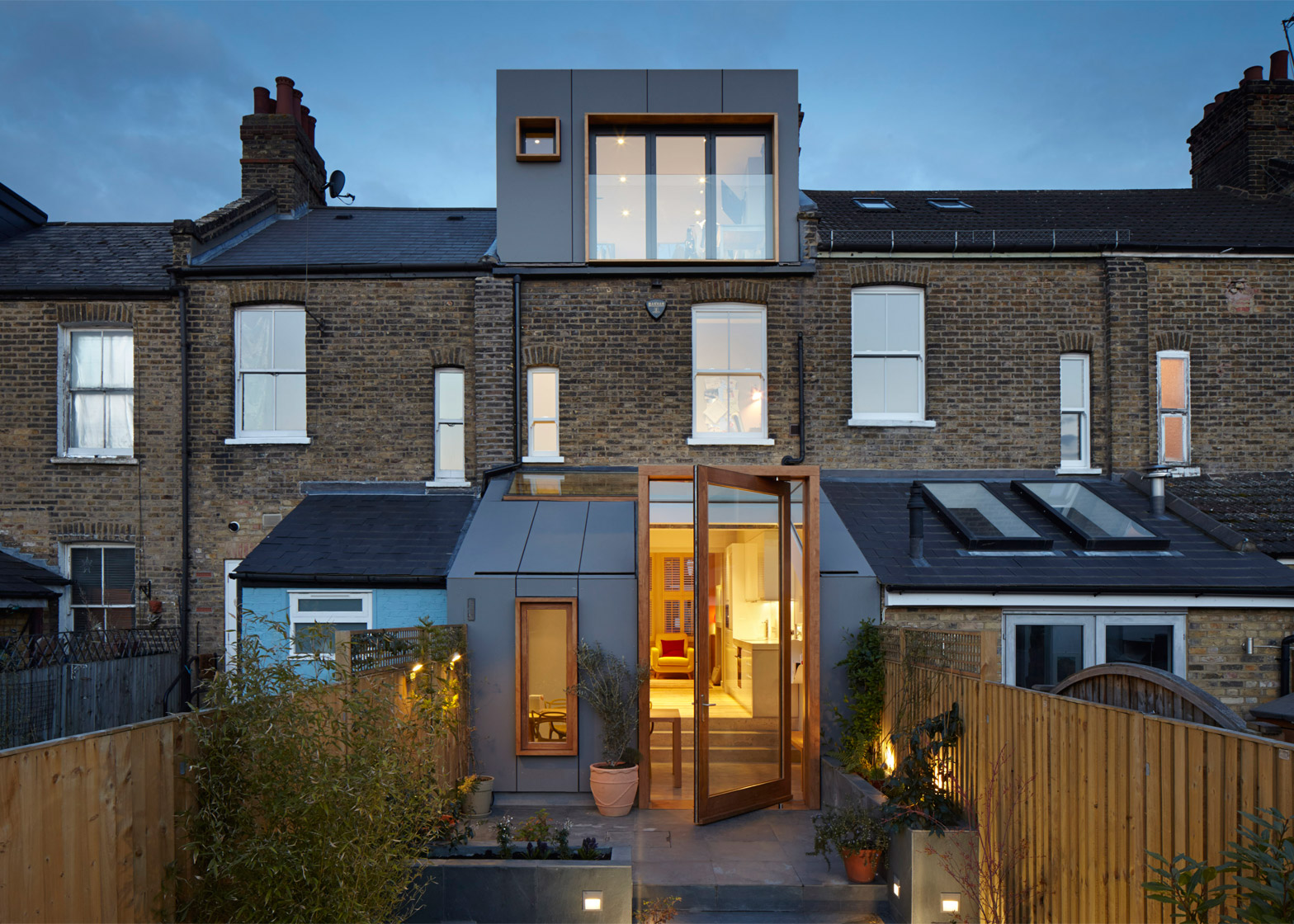
Check out the front-side picture. What do you think would happen to resale value? If you think property owners will continue to buy houses and give up any hope of actionable damages in the race to the bottom of this tragedy of the commons, you're delusional.
That's your own fault for being delusional enough to think that you should buy a house as an "investment" (or even worse as speculation because you think it will go up high and fast)
Buy a house if you like it and want to live in it for the next 30 years. Then you won't care about resale value.
Should we also feel bad for people who decided to short a bunch of random stocks because they had a gut feeling? Mortgages are highly leveraged, and are not inherently a safe investment. What makes them safe is when you're buying something you intend to live in anyway, because you'll always need some form of housing, you're just prepaying for it.
Besides, long term, this will make the neighborhood denser and ultimately increase land value. As long as you hold on long enough your resale value may actually go up. Either way, resale value is not something legitimate everyday people should be concerned with, only speculators. If you're not ready to commit to live somewhere for the next 30 years, rent.
Move somewhere else, probably somewhere with a home owners association where you can rest peacefully knowing your neighbors are not planting gardens [1][2] and painting their house improper shades of beige.
It's not on your property and it was built up to local code and zoning regulations.
Gee, that might be difficult, given that you probably have to sell the house for close to what you bought it to do that so easily (plus even if the house sold for the exact same price you're out a ton of money in closing costs for both deals).
In the U.K. if something like that was built it would put up the value of the smaller units as there is potential for redevelopment.
The UK has a lot of Victoria era terraced houses, and in big cities it's pretty common to see the attic converted into another bedroom or an extension build on the garden [0]. If you are the first person in your street doing it, you'll have a hard time getting permission from the council, but if someone else has done it, it'll be a lot easier.
There is an inherent contradiction in this idea. Part of being able to do whatever you want is setting up a homeowners association which are defeat the goal of freedom.
That's fine, as long as a propertyowner not currently in a HOA cannot be forced to join a HOA, not even if 99% of their neighbors voted to join.
You can still go somewhere where there isn't a HOA or there is a competing HOA. In many US cities today, there is no option, because zoning is municipal, not a HOA rule.
There are cities where the zoning only allows houses in an HOA. Viera in Florida is an example of this.
These days, builders always create an HOA. The options to avoid an HOA are very limited. You can settle for something really old. In theory you can become a builder yourself, but buying 30 acres and putting in streets and storm drains and... is a huge investment and a huge amount of time and effort. Even then, there are places where you simply can't do it due to zoning.
> If they want to keep it empty or a small 1 family house, let them, and don't let their neighbors or city government bully them into building larger
i really like this alternate universe where you have to fight govt in order to build smaller
--
here in the bay area it's the exact opposite. between zoning [1], height limits, Discretionary Review, CEQA and "environmental impact" reviews, it is unbelievably hard to build density here.
projects are delayed in unpredictable ways ranging from weeks to years, often while a developer pays rent and property tax on a vacant lot.
the resulting artificial scarcity inflates rents, which is great for incumbent property owners. boomers who have owned property for really long time are often essentially exempt from property tax due to Prop 13. [2]
the city kinda wallows in its own bureaucracy. back in 2004, they won funding to build a rapid transit bus line on Geary St. volunteers knocked on doors, voters voted, a ballot initiative passed. just weeks ago, it passed "Environmental Impact Review".
"For god's sakes, just let property owners do what they want with their property"
We need to have zoning laws.
"You'll gradually get more density and less traffic this way over time, assuming that's what people want "
Once a city has been structured, it's nary impossible to 'unstructure'.
"The root of the problem is the impulse to be disgusted by your neighbor's choices, "
We live in a community and we have no choice but to have rules & laws - they just need to be done intelligently.
Cities like Frankfurt and Munich are very close to ideal. They have 'just right' urban density, good Trams, Subways and Trains - and it works extremely well. You can get where you need to quickly, there's not a lot of traffic - and ample choice for those who want to have a 'big house' vs. 'smaller home' vs. 'urban flat'.
North Americans really screwed up - and it has a lot to do with builders, bad zoning etc.
If people were actually 'given the choice' of semi-dense urban living + easy commute to slightly more dense suburbs - they would usually take it.
In North America - people 'have less choice' and 'less options' because one of the key ingredients: public transport (i.e. trams, trains and subways) requires some degree of collective organization, as well as some foresight with respect to urban planning.
It seems a little 'anti choice' to opt for a Euro-style city, but really, there is a lot of 'choice' and the effectiveness of basic public transport is so awesome for people that I can't imagine anybody would want to opt out.
For example, I don't think anyone in all of Europe would opt for 'less' transit services, they are usually great and used heavily - and you can still drive if you want.
Zoning laws, especially ones as expansive as what the US has, have only existed as they are for about 60 years. My still living grandmother can recollect how the process to buy and build her house was straightforward - you buy the lot from the private owner, you draft up your own design, you buy materials and you build your house. No county zoning code, no state inspector.
This is in suburban PA, where pretty much 50-70% of standing homes were built pre-zoning and there is no new home owner being "exploited" here - you simply get 2 inspectors to look over the house for code violations, deduct the cost of getting the house to code compliance from the sale price, and make that your offer.
> Once a city has been structured
There are cities around the world that have existed in some form for thousands of years. They constantly evolve and change, and to think we are at some point in progress that it won't happen anymore seems like undue hubris. Cities will absolutely continue to change, the only difference being if cities want to use the law to prevent organic change and growth, it will simply go elsewhere and the city will wither and die.
The reason NA doesn't get public transit is a vicious cycle, with historical motivations:
* Awful zoning and building code means new construction cannot happen, leading to city rot.
* City rot drives money away, and leaves the husk to the poor.
* The poor have no collective will or enough economic impact to justify investment, so the cities they reside in never see infrastructure development that would drive economic growth.
* The fleeing rich seek extraordinary zoning blockades to keep the poor (ie, minorities) out, but by taking the money with them they take the growth opportunities that attract anyone less than lavish.
* The rich become extraordinarily NIMBY to defend against undesirables moving near their neighborhoods. Additionally, they use their influence in zoning and NIMBY policy to zone / structure where they live in unsustainable and culturally hostile ways to project their desired vision for where they live.
* The economic stagnation the extreme amount of overregulation causes pushes you back to eventual rot, and you restart the cycle.
Why do you feel the need to say (ie minorities) after the poor. Are rich affluent minorities less likely to try and separate themselves from the poor? Are these rich people making an exception for poor whites?
>and ample choice for those who want to have a 'big house' vs. 'smaller home' vs. 'urban flat'.
As long as you don't actually want a big property and cars at a middle class cost. In the many US suburbs, you can get a 3000 Sq ft home with a two car garage (not included in the area calc) for less than $200k and be within a half hour drive from a major city center.
So those German cities are only 'ideal' if you have different priorities.
No, they arent really compatible. Good transportation requires high density or or high property values to pay the taxes required to build it.
I'm not aware of any city in the world where someone can purchase a 3000 Sq ft+ property with a two car garage for less than 4x the average annual family income and have access to amazing public transportation.
Everywhere has busses, trams, trains and cities have subway.
If you really want a huge home and want to 'ride public transit' - then it's possible to get one near or by a bus route, or a short walk from the station at the village.
Or you can buy a little further out, and drive 2 minutes to the village and catch the train when needed.
"Good transportation requires high density or or high property values to pay the taxes required to build it."
No, it just requires foresight, social buy in and a tax base.
Almost everywhere in Europe has really good transport - and it actually is possible to buy big homes, very few want them.
I have been to Europe, many times. Any houses actually near good public transportation (good = frequent and wide reaching enough to not need a car), are either small or very expensive.
>Almost everywhere in Europe has really good transport
No, it doesn't. If your bar for good public transportation is a bus route and a drive to a nearby train station, then the US has good public transportation as well because every city has buses.
Good transportation is within the cities like Paris, Vienna, Rome, London. Trains run at least every 10 minutes and can get you nearly anywhere in the city within a half hour. It has to be good enough that it's actually faster and more convenient than driving. All of the houses on these train stops are very expensive or very small (or both if you're in London).
"You'll gradually get more density and less traffic this way over time, assuming that's what people want (and if it's not, they'll get what they want instead)"
That's not how it works. Aggregate preferences doesn't, necessarily, give you the best of worlds. All kind of local minimums and nasty equilibriums are possible.


You'll gradually get more density and less traffic this way over time, assuming that's what people want (and if it's not, they'll get what they want instead)
The root of the problem is the impulse to be disgusted by your neighbor's choices, and wishing to harness violent force (government rules) to force your neighbor to conform to your wishes. Enough already.