I grew up in Africa. The poverty I saw, as a child, was foundational in my own personal development.
There are some places in the US, that have that kind of poverty, but I have not seen them, with my own eyes.
I have family that dedicated most of their life to fighting poverty (with very limited success). They believe that poverty is probably the single biggest problem in the world, today. Almost every major issue we face, can be traced back to poverty.
Income inequality is one thing, but hardcore poverty, as described by the author, is a different beast, and creates a level of desperation that is incredibly dangerous.
> I have family that dedicated most of their life to fighting poverty (with very limited success).
Yes, it's very difficult to defeat poverty. But it has been happening world-wide. Poverty has been going down world-wide for 200 years. It's not so much through the efforts of individuals or even governments, just a network effect of technological advancements and opportunity creation (made possible by those advancements), and perhaps (almost certainly) by credit that makes those advancements go faster.
Only by some definitions of poverty—crucially, definitions that beg the question of rational wealth distribution. I would never, personally, defend such worldviews.
This doesn't alter anything about what I said. It's still goddamn evil how bad we are at distributing resources in this world. Justice would look like actions that are not legal to advocate for in this country.
Most resources go to average people, how is that bad? Wealth is not resource distribution, consumption is, and by far the most consumption is done by the middle class.
Consumption tax is said to be regressive since it doesn't work on rich people since they invest, that should tell you that consumption is much more evenly distributed than wealth is.
> It's still goddamn evil how bad we are at distributing resources
How. How on earth is it evil if you or I have a bit more wealth than the other? Who gives a flying fuck, except... except those who seek power. Total power. You can't have peace as long as you or your preferred leaders are not in total power, and you won't let the rest of us have peace either.
> Only by some definitions of poverty—crucially, definitions that beg the question of rational wealth distribution.
What do you care about wealth distribution? Why should anyone? As long as we each can a) not be poor, b) prosper, c) live our lives in peace, none of us should care that someone else is wealthier (or less so) than us.
"But wealth inequality!!" is just moving the goal posts: so poverty has gone down and has been going down, but you can't be satisfied with that, not even if it goes to zero. No, you want something else: power -- total power.
Sounds like the optimism rhetoric of Steven Pinker. I suggest you read up on the numerous criticisms of his work. Most of the optimism is based on a ridiculously low global poverty line conjured out of thin air, and other nonsense like GDP.
What you're saying is nonsense. I don't even know who Steven Pinker is. Poverty two hundred years ago was way worse than poverty today in most of the world -- this is a self-evident fact to anyone with even a passing knowledge of history. No running water, no water mains, no sewers -- these things meant death from cholera and other diseases for many children, and that's just for starters.
Odd how you counter claims as fictional with zero evidence just speculation. I realize this is a discussion forum and not a policy office but I pisses me off when feelings is met with feelings and not explanation or examples. Now’s your chance to really prove your point.
That we're all less poor today that our ancestors 200 years ago is absolutely, totally self-evident. No additional evidence needed. Indeed, the inverse claim would require evidence, and extraordinary evidence at that.
So much of this poverty is hidden because it makes people feel uneasy and yet it needs to be exposed, not as a means to shame them or to give you pity to feel bad about yourself but to realise, there is an imbalance and we are all part of it in a small way. That collectively, as nations, we don't need to give up a little to make a lot of change.
Because as it stands there is this notion of person all responsibility, to be Atlus holding the weight of the world. For example, it is estimated that in at lot of poorer counties, the surgery to prevent many forms of vision loss costs $20. That is wild, but it can be a source of self inflicted shame. So you want to buy Mario Kart World, it is $80... Is my enjoyment of this game worth more than the vision of 4 people? That is a wild trip to work through. There is a memorial for Mahatma Gandhi that has an incription, something like "Think of the poorest person you have ever meet and ask yourself how your next action will help them". I wish more folks would ask that.
When you see these monstrous fundings for all manner of AI stuff and wonder where we went so wrong.
The folk I respect the most are those that give up the trappings of excess in the hopes of advancing others rather than hoarding wealth like dragons. To do the opposite of what many influencers do. We need more folk like that.
I agree. I also don't know how that could realistically be achieved, with everything nowadays being lowest common denominator, aid budgets being slashed and drawbridges being raised. It would take an extraordinary initiative by an extraordinary person or group.
My parents grew up poor in manner that is more extreme than anything OP described in the post and they always remind me that its just hard work and grit.
I think there is an element of "right country, right time" when it comes to being able to escape poverty with hard work and grit, though hard work and grit always helps.
I am extremely fortunate to have been born in the US. My outcome would have been vastly harder to achieve almost anywhere else. Even in the US it was far from certain.
I'm immigrant that come to the us and always that the Americans complain is hardd to understand, like for example inflation they complain about being 3% in my country there was hyperinflation 1000%, also I didn't use to have running water(water would come every 3 days) and electricity would stop working every few days and it would take several hours or days to get fixed.
then working here there is so many jobs and you can gain skills and double your income. Most Americans have a car (in my country this is a luxury) latest ¡phone (also a luxury) and most don't cook by themselves also a luxury. I have a year here and I quickly got a comfortable living and I just don't understand it when they complain.
It's perfectly normal for a person to complain about being screwed over even if the person next to him is being screwed even harder. There will always be somebody somewhere who has it worse than you, but that doesn't mean that you shouldn't expect better for yourself than what you have, especially in a country like the US where a small number of people with more money than they could ever spend relentlessly exploit others and take from them.
Starting from nothing, it's easy to gain income and then double it, but most people eventually hit a wall and find that they can't improve their circumstances no matter what they do. Our society will conspire against them to keep them in their place. It will lay out traps for them to hold them back. Some of those traps, like payday loans, you might be able to avoid. For other traps, like our healthcare system, you will have to depend on luck to limit the number of times you are caught. Medical expenses are the reason most people in the US fall into bankruptcy.
Wealth inequality, and a lack of social mobility are huge problems in the US.
In the "wealthiest nation on Earth" 1 out of every 8 Americans can't make enough money to feed themselves without government assistance, but even for the others it's easy to gain a false sense of comfort where you are well feed and entertained, but still live paycheck to paycheck and don't have savings to protect yourself from sudden unavoidable expenses. 'Today you are fine, but always one bad day from ruin' is not a comfortable way to live.
Americans complain because even though things can always be worse, they should also be better than they are. I hope Americans never stop trying to improve their situation and the situation of those around them.
> Most Americans have a car (in my country this is a luxury)
Using this as an example to illustrate a broader point: Most Americans can't afford not to have a car. Public transit in the US is next to non-existent in many places. If you want a job, you probably need a car to drive to work every day. So you take out huge loans to pay for the cheapest car you can find: now your financial situation is precarious because you're in debt. Because you bought a bad car, you're constantly at risk of having it break down and having to pay to repair it, which is another layer of precarity.
Similarly, poor Americans do not have the latest iPhone—they have a cheap, used iPhone which could break any day, and they're extremely dependant on it. I can't speak to what life is like in the developing world, but living in poverty in the US is extremely stressful.
To be fair to iPhone point, that's sort of like saying they have a used Gucci bag. A new Motorola phone is cheaper than a 5 year old used iPhone ($130 for a new 2024 moto g vs ~$150-200 for an iPhone 12). A used Motorola is even cheaper (sub $100). Apple has always been a luxury brand. It's basically trivial next to housing, but I still can't imagine buying an Apple product.
I'll have to think harder to come up with the exact number, but I've had approximately 3 Android phones and 3 iPhones in my smartphone-career (changed phones more often in the beginning than at the end).
iPhones just last longer (and retain value a lot longer), even when compared to high end Androids (I did research online & bought the recommended brands at the time, like Google Pixel). I currently use an iPhone 11 (6 years old model at the moment, bought slightly-used a few years ago when it was a fairly new model) and have no plan to replace it anytime soon.
It is however very much a "rich people can afford to save money" boots-type situation.
A smart phone is increasingly required to do things like banking, pay bills, order things.
I live within a bike ride of a lot of places, but it would still add up to hours more a week. And for 3 months of the year there's ice and snow that are rough on the equipment.
In a democratic society, complaining is very important. It is probably why, by people complaining about a 5% inflation, the government had to take drastic moves to suppress it.
If you don't complain, you eventually won't be able to complain. If you can't complain, you take anything shoveled to you by the government, poverty being the foremost.
> It is probably why, by people complaining about a 5% inflation, the government had to take drastic moves to suppress it.
This is only a half-truth. Complaints are only worth respecting if people hold their governments accountable. There's a reason why single-payer healthcare polls higher than either party in the US. Inflation gets attention because it affects a minority of the population that matters more.
Steve Cutts <https://www.stevecutts.com> explains American unhappiness and tendency to complain (even though we've had it better than almost everyone ever).
The Pursuit Of Happiness is humanity's universal right, but our culture and the economy depends upon everybody always wanting more, and better...
Some things are fake issues created by the media to give people a reasonable sounding cover to vote for politicians that have reactionary politics that they wouldn't cop to in public.
This is why you hear people say they vote for Trump because of "the economy", even though when he and his party were in power the first time, the economy was on the downturn after he implemented policy (even before COVID) and every economist said Trump's proposed policies in 2024 would be bad for the economy. They were proven correct.
People would rather seem like single issue voters who don't understand that issue than be thought of as racist, supportive of pedophilia, misogynistic, etc. See also: "but her emails"
American living standards have declined from their peak in the mid-to-late 20th century. If you’re under 40 you will likely be materially worse off than your parents even if you are better educated than they are. It isn’t like this in the developing world, so there is still an optimism there for the young professionals benefitting from the development.
It's not so much the absolute amount you have, but rather your situation in comparison with your country men.
Yes, I know what 3rd-world poverty looks like, but, in a sense health care is more accessible to poor people in 3rd-world countries than in some advanced countries (e.g., US). Also, the morale-destroying aspect of poverty hits harder in advanced countries, because people assume you're poor because of what TFA talks about: being lazy, dumb, etc.
Poverty exists people think it ought to, that's the simple reason it exists. People think a world where some deemed unworthy have to experience crushing poverty is a more meaningful world, that's it. Certainly there is absolutely no reason that any person has to go to bed hungry, as a lot more food is produced in the world than is needed.
But the difference is that I can respect people who complain about having absolutely nothing, but I can't take seriously the complaints of rich people that they aren't richer.
You misunderstood my response. Let me explain better: I'm not saying what matters is the relative amount of money you have in relation to your peers; it is about the relative claim you have on resources, power, respect, mental health, etc.
Money and those other things may be correlated, but focusing on those things emphasizes how much money is a proxy for them.
So for example, even if you earn 100k, but many/most people are earning 500k, it cause a huge power imbalance that enables them to easily make your life miserable on a whim. It also causes society to see you as a failure, causing mental/emotional distress that further pull you into a spiral of despair.
> health care is more accessible to poor people in 3rd-world countries than in some advanced countries (e.g., US).
Do you seriously believe it's even remotely comparable? In 3rd-world countries even basic healthcare is totally inaccessible unless someone in your family is at the top level of government. If you're a worker or in a worker family even glasses are probably almost impossible to get.
> In 3rd-world countries even basic healthcare is totally inaccessible unless someone in your family is at the top level of government. If you're a worker or in a worker family even glasses are probably almost impossible to get.
I know for sure this is totally wrong, because I have lived in 3rd world countries, and I was born in one. You're just imagining stuff.
I visited a few rural cities in the Central African republic ~15 years ago and this situation definitely exists (existed?) there. Your best bet is to try to get care in a monastery, but it's not like they have glasses or anything other than basic medicine.
The root of your disagreement lies in the fact that "The Third World" isn't really a useful abstraction anymore.
Plenty of former 3rd world countries are middle-income now. There is just no comparison between living in Thailand vs. South Sudan, even though there might be in the 1950s.
Time to toss the expression entirely, it doesn't really describe anything concrete anymore. The world has changed.
That, and an environmnet that allows folks "from the wrong side of the tracks," to get ahead.
For all its faults, the US is just such a place. I suspect that many other nations are starting to improve.
At one time, the UK was a nation that you couldn't get ahead, unless you were of a certain class. I think that it is much more like the US, nowadays. You can hear lots of cockney accents in Harrods.
> I think that it is much more like the US, nowadays.
IIRC, mobility indexes crossed quite a few years ago. IOW, UK is better than the US in this respect. See, e.g., https://en.wikipedia.org/wiki/Global_Social_Mobility_Index, though it's a claim I've read based on other data and before that particular index was compiled.
Social mobility doesn't measure financial welfare and is only weakly correlated with the ability to improve your financial situation. It is largely a measure of wage compression in the economy. If everyone makes similar wages then the population will be highly socially mobile even if those wages are mediocre.
Absolute economic mobility matters much more in terms of having an opportunity to get out of poverty. High economic mobility increases wage variance and therefore naturally reduces social mobility scores since the latter is a relative rank measure.
There are countries where increasing your income $10k makes you "socially mobile" and other countries where increasing your income $50k does not.
It is a maths problem, not one of economic theory, and a well-understood limitation of "social mobility" as a measure in this context. Social mobility between two countries is only meaningfully comparable if their income distributions also have a similar degree of compression since it is a rank statistic. The large differences in wage compression between e.g. Scandinavia and the US are well documented, such as this[0] recent NBER paper, and not controversial.
Increasing rank is much easier than increasing income on a compressed distribution. Being able to easily increase income is much more important than being able to easily increasing rank if you are optimizing for economic opportunity.
Yeah, median income in the UK is about at the level of Mississippi, as is much of Western Europe (Western, not Eastern!). The US is just ridiculously wealthy, and our income inequality is largely a matter of the absurd heights reached at the top, with wide distributions. OTOH, wealth disparity (or even just the perception of wealth disparity) can be politically destabilizing and lead to some pathological social issues. Greater relative social mobility and greater (perceived?) wealth equality seems to result in a better sense of fairness, a sense of fairness is key to social cohesion and trust, and social trust is key to producing wealth. Though, social trust is necessary but hardly sufficient. Likewise, perceived mobility and equality seems necessary but not sufficient for healthy political and civic culture.
That lady has some serious chops, but she said she had to leave the UK, as she was denied opportunities, because of her "Distinctive Northern Accent" (In the UK, the "North" is considered kind of "Redneck," like our South).
Trying hard not to be and using some flimsy pretext to justify it probably accounts for 3/4 of state laws that don't pertain to a) a procedural matter b) a matter with an identifiable victim, or at least that's how it looks by my unscientific observation.
> That, and an environmnet that allows folks "from the wrong side of the tracks," to get ahead.
Vast swathes of this country look no better than the developing nations Sarah McLaughlin would go to to sing sad music and hold little kids to beg people for money in television ads.
Like I don't think you're wrong necessarily but at the same time, it really, really matters which tracks you're on the wrong side of.
> The average income is just $18,046 (£13,850) a year, and almost a third of the population live below the official US poverty line. The most elementary waste disposal infrastructure is often non-existent.
> Some 73% of residents included in the Baylor survey reported that they had been exposed to raw sewage washing back into their homes as a result of faulty septic tanks or waste pipes becoming overwhelmed in torrential rains.
...
> An eight-year-old child was sitting on the stoop of one of the trailers. Below him a white pipe ran from his house, across the yard just a few feet away from a basketball hoop, and into a copse of pine and sweet gum trees.
> The pipe was cracked in several places and stopped just inside the copse, barely 30ft from the house, dripping ooze into a viscous pool the color of oil. Directly above the sewage pool, a separate narrow-gauge pipe ran up to the house, which turned out to be the main channel carrying drinking water to the residents.
> The open sewer was festooned with mosquitoes, and a long cordon of ants could be seen trailing along the waste pipe from the house. At the end of the pool nearest the house the treacly fluid was glistening in the dappled sunlight – a closer look revealed that it was actually moving, its human effluence heaving and churning with thousands of worms.
Yup. Also: everyone reading this, celebrate that Flint, Michigan finally has water that's clean by Federal standards after just over ELEVEN. FUCKING. YEARS. That's right, America, land of opportunity, the wealthiest country on the face of the Earth (at time of comment), needed just over eleven years to get one city's inhabitants water that wasn't full to the tits with lead.
That's not NO lead, mind you, it's just now below the levels where the feds were willing to say it was a legitimate crisis. With a nod to who the feds are right now, and with a second nod to that's just at the supply line level, fuck knows how many homes still have lead pipes leeching into the taps.
Shocking absolutely no one who pays one damn bit of attention to this sort of thing: yes, Flint, Michigan is majority black.
“Used to be” such a place. Stagnating minimum wage while inflation proceeds unchecked, the rise of marginal employment and contract work. Skyrocketing housing costs.
I don’t think the us is such a place anymore. It fast becoming a place that is not.
The US was never a place like that. Even in the mostly imagined "golden age" of the fifties, if you were the wrong family or color you would not be able to reliably get out of poverty no matter how much effort or guile you could afford
The bank did not care that you would be a profitable customer, they still weren't going to lend to you.
You're projecting the current onto the past. It was a problem, but it wasn't the show stopper it would be today. Not having access to credit wasn't as big a deal when there weren't subsidized credit products and you therefore weren't competing with people who had artificial access to cheap money.
The reason minority communities exist is because those people were wealthy enough to own land, have businesses, etc. And this was before the modern idea of a home or business as a leverage investments so when they bought homes or started businesses they mostly did it where people like them were, not where a bunch of snobbish white people who hated them were (because that's where the best investment growth potential is).
Pretty much every discernible ethnic group in the history of the US has made an upward march from generally poor to more or less the same as average. There are two exceptions, native americans and blacks. And the latter was poised to do so in the 1960s. Much has been written about both so I don't feel the need to opine here.
Yeah, society was racist AF back then and imparted a lot of glass ceilings and certainly kept certain groups a little more down, but the past wasn't simply like the present but with more racism.
Yeah, and they probably had to spend money to make that happen. Night courses at a community college aren't free. A higher minimum wage makes it easier to get your foot in the door for something better.
I think that's a comforting lie people like to tell themselves. Lots of hard-working people never get their due. In reality, people who escape bad circumstances often just get lucky. That's hard to accept, because nobody "deserves" to get lucky. We want to believe we earned what we have, and that, if we had to do it all over again, we'd still end up succeeding. But often that's not true.
I think it's more comforting to think that you could've done nothing about your life being bad. It's so obvious that you need both good luck and hard work.
Both my parents came to America with less than $20 and nothing else but what they wore. I constantly think of how hard they worked to let me live such a leisurely life.
You have to be pretty well off to begin with in order to be in a position to take out $250k of student debt.
It’s the kids who can’t even imagine going to college due to living in poverty growing up that are actually “less than dirt poor”. Someone who went to a fancy college enough to get that far into debt is going to be extremely privileged on average.
You do not at all need to be well off to take $250k in student debt. In fact, the worse off you are the easier it is to do so. It’s how the US federal student loan aide works, essentially. The less you have the more they’ll loan.
Friends who grew up in middle class to upper middle class suburbs and parenting all took on college debt to varying degrees and varying outcomes 20 years later.
Friends who grew up with me in the inner city around poverty and who grew up poor or worse didn’t even consider college as an option due to the costs.
Almost no one growing up in actual poverty is going to be considering taking on six figures of college debt. The concept itself is utterly foreign and absurd. You simply already know at a young age it’s out of reach short of a full ride (sports or academic) scholarship. Even if you wanted to, your family doesn’t have the luxury of waiting for you to graduate college before you contribute to helping care for parents or younger siblings. This fact is socially reinforced by both family and your peers.
The folks I know who ended up with massive life-ending crippling student debt all grew up insanely privileged compared to the average around me. They all pretended to grow up “lower middle class” but they are outright lying to themselves (and others) about it.
It’s been interesting watching the student debt forgiveness debate under this lense. I don’t think a certain class of people understands just how tone deaf they are on the subject.
Sure there are outliers, but I’m talking about generalizations here.
I mean maybe by being a poor person in college on federal student loans I ended up naturally around other poor people in college on federal student loans and it’s confirmation bias, but what you’re saying is a little too generalized for my lived experience. Lots and lots of people growing up in poverty take that FAFSA and run - it’s what everyone says is the only way out of poverty.
I’ll give you this, though: most of the poor college students I knew (myself included) never made it to the $250k line because we eventually had to drop out because things like having to work to afford food made it harder to do well enough to stay in school and graduate.
I could say "yeah, but that was your whole country", but that was definitely your parents and everybody else doing unpleasant things for a while to improve the well-being of everyone after them. Amazing.
Edit: answer to @kragen. I have to do it like this as I'm (partially) censored on HN.
xe doesn't mention xir parents leaving China, from the context of this conversation I would assume they are still in China since we are talking about the environment where people thrived.
Well, the thing wagwang's parents did that improved the well-being of the people after them was to leave China.
What the Chinese society had been collectively doing for the previous ten years, however, was creating "the deadliest famine and one of the greatest man-made disasters in human history, with an estimated death toll due to starvation that ranges in the tens of millions (15 to 55 million)." And the following ten years included the first six years of the Cultural Revolution:
> Estimates of the death toll vary widely, typically ranging from 1–2 million, including a massacre in Guangxi that included acts of cannibalism, as well as massacres in Beijing, Inner Mongolia, Guangdong, Yunnan, and Hunan. Red Guards sought to destroy the Four Olds (old ideas, old culture, old customs, and old habits), which often took the form of destroying historical artifacts and cultural and religious sites. Tens of millions were persecuted, including senior officials such as Liu Shaoqi, Deng Xiaoping and Peng Dehuai; millions were persecuted for being members of the Five Black Categories, with intellectuals and scientists labelled as the Stinking Old Ninth. The country's schools and universities were closed, and the National College Entrance Examinations were cancelled.
I don't think any of that can be accurately described as "everybody else doing unpleasant things for a while to improve the well-being of everyone after them."
Chinese history, including in the 20th century, includes many of the brightest stars that have ever illuminated human history, and after the Cultural Revolution, a meteoric rise out of poverty, led by the same Deng Xiaoping whose son was tortured and crippled by Red Guards in the Cultural Revolution. But specifically in 01962 "everybody" was creating that poverty and worsening the well-being of everyone after them.
Immigrants show up in America having been knocked down by life here zero times and then compare themselves to people who've been knocked down generationally.
Is "by life here" doing the heavy lifting in your comment? Because obviously immigrants haven't been knocked down by life here.
I agree that folks have a pretty tough life generationally in America's rust belt. I disagree that this is unique or uniquely bad compared to many other places in the world. Although there is something pretty unique about the way American culture processes or encodes the hardship. Individualism can really make things worse...
> Income inequality is one thing, but hardcore poverty, as described by the author, is a different beast
This is something I never thought of but certainly rings true. The left always talks about income inequality and poverty as if they are one and the same. And then rebuttal almost always rebut against income inequality (or being "broke") and not poverty. By conflating the two, we're throwing the baby out with the bathwater.
Perhaps we need politicians who will accurately define poverty and policies for getting folks out of poverty, and then once everyone can afford to eat, we can talk about income inequality.
Not sure why that comment got downvoted. I guess that "income inequality" is the Boogeyman Du Jour.
I'm unhappy with it, but it is also a lot harder to address, than hardcore poverty.
A popular thing for people to do, is wring their hands and complain about problems that can't be solved, while ignoring the ones that can be addressed.
Fighting poverty is going to be tough, but fighting income inequality would be orders of magnitude more difficult, because of the entrenched and powerful folks with investment in the status quo.
If we split them, we can deal with the "low-hanging fruit" of poverty, maybe even leveraging the vast resources of the very rich, who might be more willing to help, if they didn't see it as a threat.
Maybe splitting them is helpful, but why would you have to do them sequentially? Many of the things that reduce income inequality also help reduce poverty. Poverty isn't "low-hanging fruit" and it's something people have been trying to eradicate longer than we've been alive.
Saying "let's not even think about B until we've 100% sorted A" is just a way to ensure B never gets done.
I think I gave the impression that we should tackle them sequentially with my comment. My point was that I don't think it's controversial to eradicate poverty, but for whatever reason it is controversial to eradicate income inequality. We don't need to tackle them sequentially but we also don't need to wait for a silver policy bullet that solves income inequality while we try to solve poverty as well. It may be possible to do both, but in the event it's impossible to do B at least we can still try to do A.
Everyone worries about losing their job I think. Nowadays employment is a lot more unstable. Hell a large percentage of the workforce doesn't even have permanent employment.
Flexibility is great for companies but humans need stability.
There is nothing worse than the economy going South, corporations starting to cut jobs en masse and you finding out that there are 50 other people who show up for that job interview.
Some people had good financial discipline and still fell into poverty due to business catastrophes, accidents or health problems. We need better systems to provide shields for those people, be it bankruptcy laws, universal insurance or healthcare.
Others live in unhabitable environments that can never sustain a viable economy. Until humanity finds technologies to address those environmental issues, they can never get out of poverty.
Then there are always people who are reckless and irresponsible. They are black holes of resources. Some can be educated while others do deserve to be poor. It's based their own decisions and I don't see a moral issue to leave them alone.
I’d say 99% of the poor are in the first two categories. So I don’t really care if the third category gets some stuff too if it means we help everyone else.
The spectre of the "wasteful welfare recipient" is invoked constantly, but I've never seen any of these people. The poor people I've known are, by necessity, quite careful with money.
Poverty is usually (always?) result of politics. I.e. in poor countries you have a highly dysfunctional system and elites which profiting off it. So the only way to to help is to instigate some kind of coup, eliminate warlords etc. But then how do you guarantee that whoever replaces them would be better?
Our own countries could stop actively funding, supporting and even creating that corrupt elite, for a start. See e.g. the Françafrique system in Africa.
There are some places in the US, that have that kind of poverty, but I have not seen them, with my own eyes.
Americans are very often blind to the poverty in their own backyards.
There are hundreds of thousands (millions?) of people in America who do not have electricity or even running water in their homes.
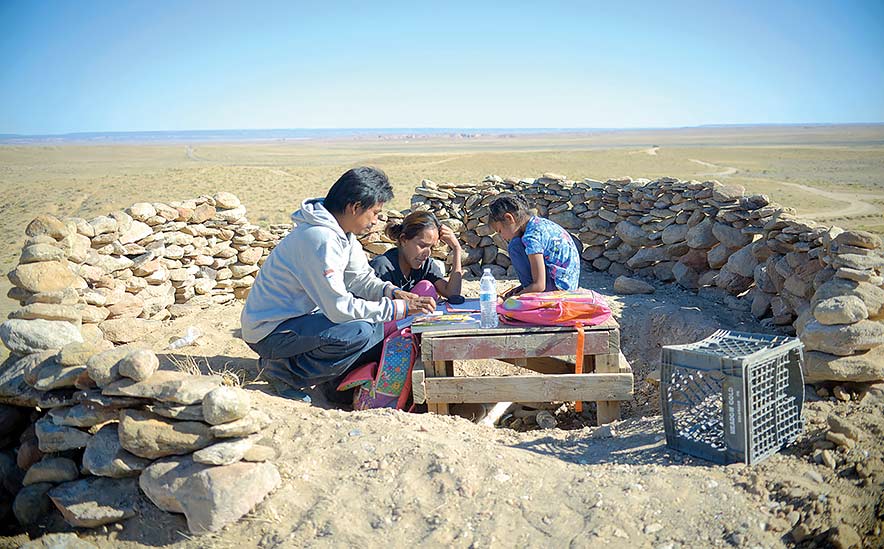
I'm always reminded of a photograph from a few years ago in the Navajo Times showing a handful of children sitting in a little clearing bordered by rocks at the top of a hill, surrounded by endless desert. That was their classroom.
No desks or chairs. Not even walls, a roof, or a floor. Just out in the open, sitting in the dirt. According to the photo caption, they had to have their classes there because it was the only place where they could get a cellular signal to do their lessons.
Edit: I can't believe I found it - October, 2020. (I took a picture of it, and it was still in iPhoto.)
Caption: Milton T. Carroll, left, and Wylean Burbank, center, help their daughter Eziellia H. Carroll, a kindergartener at Cottonwood Day School, with her school work on Monday in Fish Point, Ariz.
Carroll said he built the circular rock wall to protect his children from the elements.
I was wrong about no desk. The three of them share something that looks like it was nailed together from a discarded wooden palette. There's also a plastic milk crate nearby.
These are American citizens. In America. It's hard not to go off about the gilded ballrooms and trillion-dollar bonus packages.
Clean modern buildings, desks, air conditioning, running water, very nice. You were fooled by that photo into making a bigger assumption about the full school and situation.
The story that photograph is from is about distance learning enforced by the COVID pandemic. https://navajotimes.com/edu/hill-becomes-makeshift-classroom.... The family does not have internet access, and while they were issued a laptop and mobile hotspot, it only gets signal from the top of that hill.
OP may have misunderstood the context but I think it's a stretch to say they were intentionally fooled.
What I meant was they fooled themselves. They had negative assumptions about how Native Americans live and are treated, then they see a photo of a dirt pit, and even though it is completely implausible, assume it is a school. It is so far off reality it is notable.
Not sure exactly how obvious it is to most Americans, but the Navajo reservation is extremely poor by American standards. When I went there, the local roads were all dirt and the houses seemed to have no electricity.
I used to have Hopi and Navajo friends and I have no idea what they are referring to.
One thing I can tell you that the whole situation up there is contentious and complicated between the tribes, the states and the feds where one could support any argument as there isn't some standard "Rez Life" one can point at.
I mean, I used to have this one friend who grew up (and still had family) on a part of the reservation which was completely surrounded by the other tribe and her and my other friends (from the other tribe, don't quite remember which was which here) would get into some serious arguments at the bar over the issue where we'd have to separate them before it came to fisticuffs.
The other crime in that photo is the lack of cell service, despite billions of dollars that the USG has given ATT/Verizon/T-Mo over the years.
But these phone companies just give unfettered access to their networks to the various TLAs and everybody ignores the fact that they are not providing the cell service they are contractually obligated to.
Why would you expect there to be cell service there? Large parts of that area of the Mountain West are virtually uninhabited and have no telecom infrastructure to connect the cellular service to. There is literally nothing out in much of it except the occasional building every 10-20 miles which isn't enough to sustain a cellular network.
These days satellite would be cheaper in any case.
Why is cellular signal required for lessons? I went through 12 years of school in Eastern Europe without anyone in the entire country having cellular signal, or cellular phones. (Well mostly, towards the end they appeared, but had no effect in school). Granted, perhaps the lessons were less than perfect, but they were way better than nothing.
Look at the photo (linked to elsewhere in this thread).
If it's anything like some of the parts of the big rez I've been to, the nearest school is probably three hours away over sand/dirt roads. The teacher teaches remotely to children spread over a thousand square miles.
It's to have something better than just the bare minimum. I remember seeing similar reports about higher education in remote villages in India, with cellular networks and internet access allowing people to learn without being able to move to somewhere close to sufficiently qualified teachers.
If anyone is wondering why solving homelessness and poverty is so hard, this sibling reply is dead but I think people need to see that this opinion exists, and we need to contemplate the richest and most powerful people in this country share this sentiment:
"we're not blind to it, half of us are sick of paying for it for multiple generations, accruing interest. we're paying for poor people from 20 years ago still. let them sink, let them go away. its a test, they failed it."
Here, "go away" is a euphemism for "die from exposure".
20 years ago we had a worldwide financial crises caused by the capricious whims of the richest people in this country, they caused massive amounts of damage, destroyed people's lives and livelihoods, kicked them out on the street, and it's framed as "paying for poor people".
I often find the loudest voices with this mentality either come from well off families, or were poor enough themselves in childhood to have benefited from the government programs they wish to destroy. The first is ignorance and the second is some sort of self hatred / shame.
I rarely hear people that grew up fairly middle class and "made it" looking back at the poor as someone holding them back in this same manner.
It's always sickening to hear more educated people (compared to the average) repeating this inhumane bullshit.
Wanting people to die because they are poor, losing complete touch of why we humans even develop what we do: to the betterment of us all, to enrich all of our lives, to make the lives of future humans better. There's no other point to it, the absurd individualism is a disease, I'd much rather eradicate those from our lineage than the less fortunate, for a better future for humanity.
It's nobody's fault for becoming poor. But if you're staying poor (dirt poor) for decades, then there is something you're doing wrong. The other commenter puts it in a rude way, but there's something to it. If you evidently can't take care of yourself, then you shouldn't be given more money. You should be in some kind of institution which takes care of your basic needs.
> If you evidently can't take care of yourself, then you shouldn't be given more money. You should be in some kind of institution which takes care of your basic needs.
We used to have those in the US. Things are better for the poor now without them - a few do freeze to death in the streets today, most do not, while the abuse of those old institutions did hit most. The people who need institutions are also those least able to advocate for themselves if they are abused.
I don't like the current answer, but it could be worse and if you want something better you need to explain how it won't descend into worse. I don't have any ideas myself.
Sure, but it's the system's fault, and we can point at the people who are keeping the system the way it is. The system is what it does, and what it does is syphon money from everyone else and pumps it upward to a few individuals. That's not an accident, people are responsible for that, they like the way it works, and they're intent on keeping it that way.
Remember, in this system you get paid money for having money and you get charged a fee if you don't have enough. You get taxed more for working with capital than for owning capital. You pay more the less you buy. People always say "The hardest million was the first million". This is by design!
> You should be in some kind of institution which takes care of your basic needs.
Maybe, but we refuse to fund those because they're too expensive to operate.
Have you seen "the system" sleeping on the streets, starving, or not having enough clothes?
No matter who or what is to blame, the individual is who is paying the price and who should have the strongest interest to get out of that situation. Which means, if you're staying in that situation for years on end you have to admit to yourself you are doing something which isn't working.
Thats why people have more sympathy for somebody who is poor because they are temporarily down on their luck or born into poverty, and less sympathy for somebody who has been poor as an adult for decades.
Yes the argument that being poor is some sort of character flaw, while realistically it's just a lack of money, usually inherited from the parents. I would bet that most people who make these arguments (like everyone else) would end up permanently poor if one was to take away their money and networks.
All research (e.g. UBI trials, mirco loan experiments...) have shown that giving someone poor access to money allows them to dramatically improve their situation.
In 2024 over 700k people were homeless in the USA. That's a system failure. If you want to talk about personal failings you have to consider individual circumstances. But 700k being homeless is abjectly just not how a civil society should operate.
Yes, because human mind is famously known for being extraordinarily good at getting out of self-destructive spiraling without external help, and that help is famously known for being provided to everyone who needs it regardless of their economic status. Also, chronic lack of money has absolutely no way to contribute to that occurring in the first place. /s
I get it. Everybody gets it. For some months, even years. But after a decade or so in such a situation, you must arrive at some sort of epiphany, look at your life and say "what the fuck?".
And I don't think anybody is arguing that people shouldn't get help to get back on their feet. Rather that some people refuse to get back on their feet.
Unfortunately hackers made sure that the only reply below written by somebody who has actually been homeless was [flagged] and [dead]. That's the prevailing attitude towards poverty among the intellectuals. "Let's talk about them, not with them."
So I'll reply here, since I can't reply to a [dead]:
> And then what? You're 54 years old. No degree. No work history. Criminal conviction for drug possession. You're mentally ill and unmedicated. You realize for the first time you want to change your life. What's your first move? You have until your lucidity is interrupted by the next bout of mania and paranoid delusions to turn your life around.
You get medication and join the merchant navy as a mess hand. Not only do you get food, a safe bed, medical attention, safety, a salary, and companionship. You also get away from a destructive environment, drugs, threats, and all that shit that made life hell.
If you'd be actually experienced, you would realize that there's an autokill filter on HN and the comment in question contains the forbidden M word. Apparently my vouch wasn't enough to resurrect it.
Makes sense (I run showdead=no, so I never saw the original), but that doesn’t make my comment any less accurate. We all see this stuff happen on a regular basis.
A long discussion is going on, with people flinging poo, back and forth, and one comment appears, from someone actually in the industry/organization being discussed, or by someone with very relevant direct experience, and that comment gets immediately dogpiled; often by both sides. It’s happened to me, a couple of times. I’ve learned to just stay out of these shitfests, even if they are embarrassingly offbase.
With this kind of emotionally-charged, nontechnical topic, it’s even worse than things like OS or methodology dogma battles.
No. After a decade the ‘what the fuck’ is just a distant memory. ‘It is what it is’, ‘nothing ever works out’, other kinds of depression just win by default.
If it only pumped the money to a few individuals someone would've pushed those individuals off a cliff and seized power by now.
The magic of the system is that there's enough trickle down to motivate the petite-bourgeois (I hate Marx, but I'll be darned if he didn't enumerate some good economic tiers) to make them keep the system running.
Your media talking heads peddling division, your 200k+/yr software engineers implementing extractive algorithms to make the gig economy tick, etc, etc, etc.
No, I doubt they are. Most people who are on the streets chronically are there because they’ve burned every bridge. Most people have a dozen friends or family who would gladly give them the guest room for a few weeks if they had a job loss that put them at risk of hard times — on the other hand those who mysteriously have zero friends or family usually got that way by the same antisocial behaviors that contributed to their problems in the first place, until every last person that once cared said “don’t come around here anymore.”
Not saying anyone’s a Bad Person for this, but treating everyone like zero-agency victims or helpless children has never fixed anything. You can’t fix people without at least their partnership, and generally it’s substances and severe mental illness that gets in the way of the cooperation. “Bitter pills to swallow” as the meme goes but anyone who doesn’t admit this is kidding themself.
> who would gladly give them the guest room for a few weeks
Yeah, a couple weeks and then what? Couch-surfing is a form of homelessness, and the membrane between sleeping on a couch and sleeping on the street can be very thin, especially when your health makes it unlikely you'll find work in the near future. Something as simple as a concussion can stop you from working for months.
> but treating everyone like zero-agency victims or helpless children has never fixed anything
I hear this argument a lot, and I find it baffling. What's your proposal here? That we all wag our fingers at homeless people? The people with agency who can fix their situations on their own already did—in fact, they course-corrected long before they slid into poverty or homelessness in the first place. If they had agency, they wouldn't be in this situation.
That's why I dredged up the dead comment in the first place stating it plainly "let them sink, let them go away." At least that poster was honest about the end game.
Lot of other posters here on HN seem to feel the same way but they're rationalizing it with "well, they deserve it after all". It's their fault "because they’ve burned every bridge." It's their fault because "most people have a dozen friends". It's their fault because "substances and severe mental illness that gets in the way of the cooperation."
And if we don't agree with this assessment, it's we who are not serious. But left unstated is: their way just ends up leaving this vulnerable population to die, and they really don't have a problem with that, because according to them, it's their own damn fault.
I believe the latest solution to homelessness proffered in the public sphere was from Brian Kilmeade, who said "involuntary lethal injection, or something. Just kill 'em." A final solution if you will.
Then they need to start supporting themselves. Or at least not strew needles all over the friend’s living room and pawn their valuables to buy more meth.
Most of those friends would settle for just the latter for several months, but the worst cases 100% got kicked out of even family members’ homes for that kind of thing and that’s why they’re on the street.
10 trillion dollars of welfare, free houses, cash, whatever, is not enough to fix addicts who don’t have an insane amount of willpower. Which most people just don’t have. Drugs are mostly the problem. Most non-addicts sleep in their cars and rely on friends for a month or two and get their shit together. “Homelessness” numbers always conflate both kinds: the lost causes and the temporarily homeless.
I can tell your income bracket from this phrase alone:
> Most people have a dozen friends or family who would gladly give them the guest room for a few weeks.
No, most people do not.
I am aware of classic triad of "malignantly antisocial personality + substance abuse + criminal record" that makes people stay on the streets.
But a lot of people end up on the streets simply because they were already only one notch above financial destitution and so all of their friends and family.
Lose a job + get sick in body or mind, even temporarily = game over. "Friends and family" who are also financially vulnerable would ruthlessly shed the load of extra mouth to feed, much less to house.
The friends and family route works the first time around. You couch surf until you find a job, as you go through your contact list people are happy to host at first, but there comes the awkward "so... it's been a couple weeks... how's that job search going?". Then you have to put your job search on pause until you find a new place to live.
Eventually your job search keeps turning up "no" because they don't like the answers to "can you explain this gap on your resume?" and they really don't like the answer to "do you have a permanent residence" or "do you have any drug-related convictions?"
Hopefully you find a job before you've exhausted the good will of all your friends. And pray to GOD it doesn't happen again because the next time around, each one will have an excuse as to why they can't host you. "Oh sorry, we've got our inlaws, try X, Y, Z"... who are also "unable" to host.
So then your car is your home. If you're lucky enough to have one. But the point is "just have friends" isn't a solution.
I wouldn't say so. A large percentage of the population - double digits - have never had any job security in their lives, or any guarantees whatsoever. We've learnt to adapt and know we can do it again. People aren't allocated 1 job per person for life and if we loose that job we're in the shit for life. Most people know they can get another job.
Legality only matters insofar as people use it as a mental shortcut to turn off their brains.
Which TBH I think is way less than it used to be, but feels like it's more because so much more stuff involves law and government than it did 50yr ago.
I grew up in Kentucky and spent a lot of time in the areas around the Red River Gorge in the southeastern part of the state. Some of the poverty there is shocking. The movie Winters Bone actually seemed to do a decent job of showcasing similar areas.
It's difficult to find trustworthy statistics quickly, but the penetration of electricity and running water in US households is only about 99%. At the scale of the US (~130 million households), 1% of households lacking electricity equates to over a million households and somewhat more in terms of number of people. So yeah, there's probably about 1-2 million people in the US without running water and/or electricity.
Where are these people? Probably the largest concentration of such people are on the various Native American reservations (I believe ~15% of the Navajo Reservation lacks running water). The hinterlands of Alaska also likely has a high number of these houses.
"Energy insecurity" transforms the problem from lack of "energy" into an emotional problem. The problem isn't feelings of insecurity, it's lacking electricity. But now we can feel all self-righteous that we're making people feel better because we don't call them homeless and hungry and in the dark. Now they "have housing insecurity" and "have food insecurity" and are suffering from "energy insecurity".
I lived for a month in a dorm in China quite a few years ago, where they had running water for an hour every other day. Hot water for tea was delivered in a thermos every morning. Nobody had "heated water insecurity". Everyone knew exactly how it worked, and they all showered two or three to a shower. I couldn't bring myself to do that, so I showered after they were all done, usually in cold water. The problem was very clearly lack of hot water, not "insecurity".
I mentored a kid for a few years whose family occasionally couldn't afford meals, so they had "fend for yourself night", where he had to figure out how to get a meal on his own. His problem was not "food insecurity", his problem was that he was hungry. Any "food insecurity" he might have had was distinctly downstream from his lack of food, and would have been entirely eliminated with regular meals.
I'm not saying literally everyone in America has electricity/running water. I'm saying it's a rare exception, not "hundreds of thousands (millions?) of people".
And when it is a problem, it's usually a problem with the system denying people access rather than literal inability to afford.
Municipality would rather some house be vacated (perhaps based on a "poor people drain services, kick-em out" policy posture) so when a storm takes out your utility pole guess who isn't getting a new meter drop until they bring their shit up to current code at a non-starter price... and oh look here it's illegal to live in a house without electricity. I guess that means someone's getting evicted, what a shame...
This is just not true. America has many problems but access to electricity/running water simply is not one of them.
You are disconnected from reality.
I can take you to places in Texas, Arizona, New Mexico, West Virginia, and even California where people have to live without electricity, running water, or both.
I'll take the word of what I've personally seen with my own eyes over someone who created an HN account three minutes ago.
> I'll take the word of what I've personally seen with my own eyes over someone who created an HN account three minutes ago.
> I can take you to places in Texas, Arizona, New Mexico, West Virginia, and even California where people have to live without electricity, running water, or both.
But can you provide us with a source other than your own eyes for the "millions of people" you claim to be living in such conditions?
There are Americans who have open sewage in their yards [0], because their counties are predominantly Black or Latino, and their state deprioritizes any infrastructure work. It’s structural racism.
Even better, the Trump administration canceled [1] an attempt to right that wrong, citing that it was “DEI.”
What the Trump administration canceled didn't right that wrong. What the Trump administration canceled was an agreement for the local county to stop issuing fines, which had already been in effect for over two years. And within those two years, the local county built zero sewers, zero hookups. They literally built nothing in two years.
The original agreement under the Biden admin, which to be clear, the President doesn't personally oversee these kinds of agreements, this is sort of all within the DOJ, but the original agreement doesn't even require them to build the sewers. It literally just requires them to run a public health campaign and not issue fines.
I guess the DOJ saying not to fine these people is a nice gesture but in practice local fines don't mean anything in a situation like this unless the poors on the property are unlucky enough to be on a property that the municipality wants to lien and take for whatever reason.
Whatever the dollar number is, it's likely some insane punitive number (hundreds to thousands per day) that nobody could ever pay and never will actually be enforced, it's basically just a threat and you wind up going to court over it in the end or you fix it and they drop it or fine you a reasonable amount (thank the 8th amendment).
This sounds like a standoff situation. Municipality wants trailer park to pay for its own sewer. Trailer park can't afford it. Municipality fines them. Trailer park gives them the bird because they're so poor they're basically judgement proof. Municipality doesn't push the issue because if they take it and kick them all out then they will pick up the tab for remediating, etc, etc.
What should have happened in the original agreement is that the fed pays for the sewers at a very cheap rate and the municipality does the work and owns it for eg 10-20 years.
That's actually a really common agreement. I don't know why DOJ had such a derp moment here and instead demanded billboards about health risks for people who don't have the money for basic medical care much less exploratory lab testing.
They're called sewage "lagoons" and work basically the same as septic systems from a environmental impact perspective.
They only really work well in certain climates and even then you need to have enough spare land to just locate a sewage pond somewhere. Even in richer areas it was dirt common for schools and prisons (which aren't likely to be located in the center of town like other government stuff is) to have them way deeper into the 20th century than you'd expect since it's not like they were short on land (just use more taxpayer money).
Normally the plumbing runs underground but those people have a trench solution likely because they added a bunch of trailers to the property and more lines were out. There's probably some weird government rules at play here. Like they don't want to dig pipes into the ground because screwing with their grandfathered in lagoon would be "state problems" level illegal whereas right now it's "municipality problems" level illegal and the latter doesn't wanna stomp them with the jackboot for obvious political reasons.
The clean water act and it's knock on rules really act as a huge impediment to "it won't make it compliant, but it will make it a hell of a lot better" fixes in cases like this.
I went to school with kids who didn't have winter jackets. In Northern Maine. I studied with kids who didn't have any food to eat, almost ever. My mother taught kids that were kicked out and homeless at like 16. One child was named after a beer. Entire classrooms worth of kids being "raised" only by an impoverished grandparent who wasn't able to leave the house and couldn't really do anything and had only minimal social security checks for income.
There was a family that lived in a 10ft by 10ft shack and had 6 kids and basically nothing else to their name. One daughter was hit by a dump truck getting off the school bus and died.
My own family was impoverished for a long time. Sometimes the only food left in the house was old flour with bugs in it. The mental toll it took on my mother is still clear and evident, and I myself still have deep "scarcity mindset" behavior, and our situation wasn't even that bad. We technically were above the poverty line. We had a home that was clean and well built and very cheap ($400 a month mortgage). My mother had an education and a career, and my dad's employer was in control of making his child support payments, so they were always on time. My mom was really smart and extremely good at stretching money and playing the games required to cover your bills when you literally make less money than it takes every month to be legally alive, like making friends with the telecom neighbor who will set you up with free cable for a bit out of pity. Her job in government ensured we had good health insurance and visits to doctors. We had much wealthier family who kept us clothed with truckfulls of handmedown clothes from the previous decade. She had great credit and could manage credit cards very well.
It almost killed her a bunch of times though. Once when I was 12, she called my dad to come get me because she couldn't get herself out of bed and was bawling and openly talking about suicide. She couldn't really afford therapy and the local therapists in bumbfuck nowhere aren't good at their job anyway. Turns out there's a medically important distinction between "Therapist" and "Psychologist" and in the 90s neither was equipped to handle "Undiagnosed neurodivergent driven to the very end of their wits and surviving exclusively on adrenaline".
Yet there are people on this very board insistent that people do not starve in America (before Trump decided we didn't need to report on it and thus killed the program tracking it, it regularly reported millions and millions of American children literally go hungry. Free lunch and breakfast programs reliably improve grades and education outcomes still because children are hungry)
There are people who insist it is cultural or based on making bad choices.
> But, I absolutely hated working in an office. I also hated what digital marketing has done to people’s privacy. I had to get out. So, after 10 years I left and went back to my roots. I founded a sprinkler contracting business with my brother and work outside all day, every day. And I love it.
I don't think this person should be putting themselves in the same category as people who are stuck in poverty with no options.
> I have a van that is falling apart. It needs a lot of work that we cannot afford to do. In the mindset that poor people are unskilled, it appears that I should watch some YouTube videos, get the parts, and do it myself
I’m not saying running a small business is easy. But they previously worked a corporate job and chose to start a landscaping business partly for lifestyle reasons.
It's not as well written as it could be. He's using the first person, but he's not actually referring to himself. It's a hypothetical. Pretend he put the word "Suppose" in front of the first word, as in "Suppose I have a van that's falling apart."


I grew up in Africa. The poverty I saw, as a child, was foundational in my own personal development.
There are some places in the US, that have that kind of poverty, but I have not seen them, with my own eyes.
I have family that dedicated most of their life to fighting poverty (with very limited success). They believe that poverty is probably the single biggest problem in the world, today. Almost every major issue we face, can be traced back to poverty.
Income inequality is one thing, but hardcore poverty, as described by the author, is a different beast, and creates a level of desperation that is incredibly dangerous.
[0] https://blog.ctms.me/about/